What alloy grade and profile wall thickness are essential for heavy-duty commercial aluminum doors?
For true commercial storefronts and high-traffic public entrances, the global standard is architectural 6063-T5 or 6063-T6 alloy. Guangdong Dejiyoupin Doors and Windows Co., Ltd. specifies minimum profile wall thicknesses of 2.0 mm to 3.5 mm on primary load-bearing members. This provides the structural rigidity necessary to prevent frame twisting under continuous cyclic door closer operation and high positive/negative wind loads.
How do thermal break commercial aluminum doors improve building envelope energy performance?
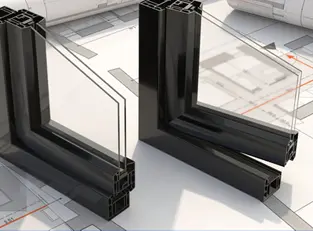
Standard aluminum is highly conductive (thermal conductivity approx. 160-200 W/m·K). Our thermal break systems physically isolate interior and exterior aluminum profiles with continuous structural polyamide (PA66 GF25) insulating struts. Combined with double or triple insulated glass units (IGUs) incorporating warm-edge spacers, argon filling, and Low-Emissivity coatings, overall door U-values drop to 1.4-1.8 W/(m²·K), dramatically reducing building HVAC energy demand.
What certifications verify compliance for international tenders?
Guangdong Dejiyoupin Doors and Windows Co., Ltd. holds comprehensive international testing certifications. Our commercial systems conform to CE EN 14351-1 (Europe), NFRC thermal and solar heat gain ratings (USA), AS2047 and AS4284 (Australia/NZ), CSA standards (Canada), and ISO 9001:2015 quality management systems. In addition, our impact lines comply with Florida Building Code TAS-201/202/203 high-velocity hurricane protocols.
How does the patented Four-Side Six-Point Lock enhance commercial perimeter security?
Unlike common commercial center deadlatches that leave top and bottom corners vulnerable to forced entry, our proprietary Four-Side Six-Point Locking invention patent operates via concealed heavy-gauge internal tie-rods. A single turn locks the perimeter into hardened steel frame receptacles, resisting crowbar forced entry, seismic lateral shifting, and high wind-pressure deformation.
What surface coating is recommended for coastal or high-pollution commercial projects?
For marine and industrial environments within 5 km of coastlines, we mandate either 3-coat fluorocarbon PVDF coatings (polyvinylidene fluoride meeting AAMA 2605 specifications with 70% Kynar 500 resin) or architectural Class 1 anodizing (minimum 25 microns). These finishes withstand salt spray testing beyond 4,000 hours without chalking, blistering, or galvanic degradation.
How are commercial aluminum doors packaged and documented for international sea freight?
Orders are packed to withstand multi-modal maritime transport. Frames and sashes are protected with low-tack protective film, corner edge guards, high-density polyethylene foam sheets, and sealed within fumigation-free OSB wooden crates reinforced with steel bands. Full export documentation includes commercial invoices, itemized packing lists by floor and elevation, bills of lading, certificates of origin, and destination-specific certifications (such as SONCAP, PVoC, or SASO).
Can commercial entrance doors integrate with building access control and automation systems?
Yes. We factory pre-machine internal channels and reinforcement plates for electronic hardware integration. Profiles can accommodate concealed magnetic locks, motorized electric latches, touchless sensors, card readers, panic fire-exit push bars, and integration leads connecting directly to central Building Management Systems (BMS).