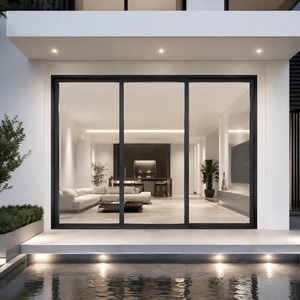
Precision Engineering Portfolio
Engineered Aluminum Exterior Systems: Factory Catalog
Precision-milled structural profiles, acoustic insulating glazing, and weather-defying hardware built for extreme climate envelopes.
180,000 m²
Production Infrastructure
State-of-the-art manufacturing hub located in Nanhai, Foshan, housing high-precision CNC multi-axis extrusion lines.
1,000,000+ m²
Annual Capacity
Industrial-scale capacity guaranteeing reliable delivery cycles across mega commercial towers and bulk residential developments.
100+ Patents
Proprietary Technology
Including patented Four-Side Six-Point locking mechanics, thermal barriers, and drainage anti-reflux systems.
18,000+ Projects
Global Deployments
Verified installations engineered to withstand harsh coastal air, extreme desert thermals, and Category 5 wind loads.
Global Fenestration Matrix: Evaluating Tier-1 Aluminum Door Manufacturers
In contemporary architectural design and structural engineering, specifying exterior opening assemblies has transcended mere cosmetic appeal. Commercial architects, procurement directors, and building envelope consultants now evaluate the Top 10 Aluminum External Doors Manufacturer & Suppliers against rigorous metallurgical, thermal, acoustic, and kinetic performance parameters. The exterior doorway represents the most vulnerable breach point in any building’s thermal envelope and physical security perimeter.
An enterprise-level manufacturing supplier must prove verified capabilities spanning structural finite element analysis (FEA), precision multi-cavity thermal break extrusion, advanced surface chemical passivation, and fully automated robotic glass assembly. Whether sourcing high-span sliding patio assemblies for beachfront villas or heavy-duty hurricane-rated impact entrances for coastal developments, this guide provides the technical information architecture required for zero-defect supply chains.
Metallurgical Standards & Architectural Extrusion Quality
The core structural foundation of all commercial aluminum entrance doors relies on raw alloy chemistry. Premier suppliers strictly reject scrap remelts in favor of primary billet 6063-T5 or 6063-T6 architectural-grade aluminum alloy, with specialized heavy commercial entrances deploying 6061-T6 for heightened flexural yield strength. Chemical compositions must strictly adhere to ASTM B221, EN 755, and GB/T 5237 benchmarks to ensure uniform wall thicknesses (minimum nominal wall threshold ≥ 2.0 mm for heavy-duty hinged doors, and ≥ 2.5 mm to 3.0 mm for oversized multi-slide tracks).
Secondary-grade aluminum matrices contaminated by uncontrolled iron or silicon ratios suffer from micro-crystallization fractures during the hydraulic crimping process of corner cleat assembly. Tier-1 manufacturers utilize cast aluminum internal corner brackets joined by pneumatic, multi-point mechanical crimping machines, backed by two-component polyurethane corner expansion adhesives (injectable structural matrix). This eliminates moisture weeping through the 45-degree mitered joints and stops perimeter sag even under cyclic wind pressures exceeding 4500 Pascals (Pa).
Polyamide Thermal Barriers
PA66-GF25 (polyamide reinforced with 25% chopped fiberglass) thermal break struts mitigate thermal bridge conductivity, delivering U-factors down to 1.1 W/m²·K in cold or scorching climates.
Four-Side Multi-Point Locks
Patented 6-point perimeter deadbolt engagements deploy hardened stainless steel claw hooks, preventing pry-bar jamb deflection and achieving Grade 40 forced entry resistance.
Fluorocarbon PVDF Coatings
Tri-coat Kynar 500 / Hylar 5000 PVDF electrostatic finishes comply with AAMA 2605 specs, guaranteeing chalking resistance, color retention, and 3000-hour ASTM B117 salt-spray tolerance.
Future Sourcing & Procurement Trends (2025–2030 Horizon)
Procurement workflows for commercial fenestration are undergoing fundamental shifts driven by international net-zero building codes, volatile regional supply chains, and advanced life-cycle analysis (LCA). Specifying parties must adapt their purchasing checklists to accommodate three decisive trends:
1. Deep Carbon Decarbonization & Low-Carbon Aluminum Sourcing
With the enforcement of the European Union’s Carbon Border Adjustment Mechanism (CBAM) and comparable global sustainability taxonomies, standard high-emission smelting practices are becoming non-compliant for institutional projects. Strategic developers now mandate that tier-1 suppliers provide Environmental Product Declarations (EPD) proving the use of hydro-powered or renewable-energy-smelted primary aluminum, capping embedded carbon emissions below 4.0 kg CO₂e per kilogram of finished profile.
2. Factory-Integrated Building Envelope Assemblies
Job site labor costs and localized skilled-labor shortages have made field-glazing large external entrance doors economically unfeasible and prone to quality errors. Modern procurement requires factory-glazed, fully unitized sub-frame door modules. By delivering complete pre-hung assemblies with dry-glazed continuous EPDM vulcanized gaskets, automated helium-filled insulated glass units (IGU), and concealed motorized drop-seals installed under controlled factory conditions, developers reduce on-site installation intervals by over 60%.
3. IoT Integration and Concealed Mechatronic Automation
Smart building management systems (BMS) have made mechanical lock cylinders obsolete in high-end commercial and private villa segments. Next-generation aluminum entrance doors feature concealed electro-mechanical multipoint operators powered via integrated frame transfer loops. High-speed optical biometric scanners, wireless smart hub relays, and motorized soft-closing planetary gears are directly integrated into profile thermal break cavities without disrupting thermal performance lines.
| System Architecture | Typical Profile Gauge | Thermal Metric (Uw Value) | Wind Load Resistance | Ideal Architectural Application |
|---|---|---|---|---|
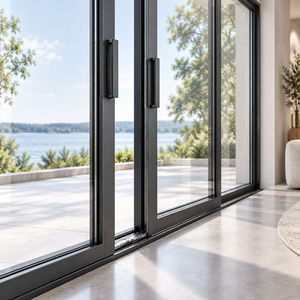
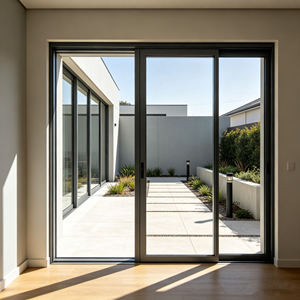
| Thermally Broken Multi-Slide | 2.0 mm – 2.5 mm | 1.4 – 1.8 W/m²·K | Class C4 (ASTM E330) | Luxury Courtyard Villas, Oceanfront Panoramic Patios |
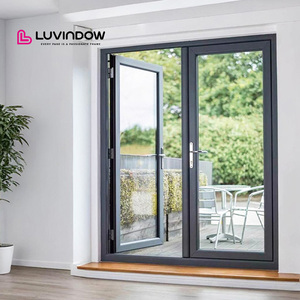
| Hurricane Impact Heavy Swing | 2.5 mm – 3.2 mm | 1.3 – 1.6 W/m²·K | DP70 – DP90 (ASTM E1886) | High-Velocity Coastal Zones, Commercial Grand Portals |
| Heavy Duty Rolling Security Shutter | 1.5 mm – 2.2 mm (Double Wall) | 2.4 – 2.8 W/m²·K | Class 4/5 (EN 12424) | High-Security Logistics Centers, Commercial Storefronts |
| Minimalist Narrow-Stile Pivot | 3.0 mm + Steel Core | 1.5 – 1.9 W/m²·K | Class C3 (ASTM E330) | Modernist Signature Residences, Commercial Headquarters |
| Bespoke Dual-Finish Thermal Entrance | 2.0 mm Multi-Cavity | 1.1 – 1.4 W/m²·K | Class C5 (ASTM E330) | Extreme Climate Envelopes (Desert & Sub-Zero Regions) |
Technological Evolution & Future Engineering Paradigms
The architectural envelope is migrating from a static barrier to an active climatic interface. Technological differentiation among top-tier manufacturers centers on advanced micro-engineering breakthroughs:
Vacuum Insulated Glass (VIG) Hybridization: Traditional double-glazed argon IGUs with 12 mm to 16 mm cavities are being upgraded to hybrid composite glass layups. Combining a 6 mm tempered low-iron outer lite with an 8.3 mm tempered vacuum glass core drops center-of-glass U-values down to an incredible 0.45 W/m²·K—rivaling insulated brick cavity walls while cutting profile structural frame depth requirements by 30%.
Pressure-Equalized Rainscreen Aerodynamics: Wind-driven monsoonal rain cannot be managed through perimeter silicone seals alone. Leading manufacturing engineering integrates internal chamber baffle valves that calibrate pressure differences between the exterior atmospheric profile surface and the internal drainage chamber. By balancing pneumatic pressure, water droplets are denied mechanical entry forces and flow naturally through concealed, downward-slotted bottom weep channels.
Systematic Quality Verification: 8-Stage Manufacturing & Engineering Lifecycle
To ensure precision manufacturing that prevents on-site delays, each unit goes through an unbroken, documented quality-assurance workflow:
01
BIM / CAD Review
Full cross-section review checking structural deflections, wind loads, and thermal boundaries.
02
Alloy & Extrusion QC
Primary 6063-T5 alloy billets checked via spectrometer testing for zero impurity concentrations.
03
PA66 Crimp Testing
Automated transverse pull-off force testing on multi-cavity thermal break extrusions.
04
CNC Miter Milling
Sub-millimeter CNC multi-axis milling of corner joints, drainage weeps, and lock boxes.
05
IGU Robotic Sealing
Automated robotic structural silicone extrusion, argon gas backfilling, and dew point checks.
06
Hardware Integration
Installation of multi-point locksets, heavy-duty stainless hinges, and friction stays.
07
Chamber Air/Water Test
Sample testing under dynamic spray arrays and air pressure pumps simulating hurricane storms.
08
Export-Grade Crating
Multi-layer peel-off film, corner foam protectors, and reinforced steel-strapped timber crates.
Enterprise Manufacturing Dominance & Proven Supplier Advantages
Backed by over 25 years of specialized manufacturing experience at our world-class 180,000 m² modern production facility in Foshan, China, our company represents elite engineering in architectural fenestration. Officially recognized as a "China Famous Brand" by Xinhua News Agency, we merge heavy industrial capacity with tailored project delivery:
International Grand Slam
Accredited across major global fenestration standards including CE (EU), NFRC & Hurricane Impact (USA), AS2047 (Australia), CSA (Canada), and ISO 9001 quality systems.
Industrial Scale & Delivery
1,000,000+ m² annual output delivered by 600+ skilled technicians and 30+ dedicated R&D structural engineers, guaranteeing rapid turnarounds on bespoke developments.
Worldwide Project Experience
Over 18,000 completed architectural installations spanning premier hotels (Hilton, Atour), high-end residential estates, and complex commercial projects across the globe.
Strategic Procurement FAQ: Critical Questions for Global Importers
Sourcing high-performance exterior aluminum entrance doors requires direct answers to operational, engineering, and logistics considerations. Here are the core specifications project engineers and import managers ask our engineering team:
What surface treatment stops coastal corrosion long-term?
For coastal deployments within 5 kilometers of the shoreline, we specify fluorocarbon PVDF finishes (70% Kynar 500 resin base) or marine-grade hard-anodizing exceeding 25 microns (Class I). Combined with marine-grade 316 stainless steel fasteners and EPDM gaskets, our systems resist salt fog corrosion for decades without pitting.
How do thermal break profiles perform in scorching desert heat?
Thermal breaks work bidirectionally. In high-temperature zones like the Middle East or inland Africa, multi-cavity PA66-GF25 structural polyamide struts stop outside frame heat (often reaching 65°C+) from conducting into conditioned interior living spaces. Paired with Low-E argon solar-control glass, this drastically cuts air conditioning electrical loads.
What testing ensures hurricane impact and high wind ratings?
Our systems undergo dynamic large missile impact tests (firing 2x4 lumber at 50 ft/s) and cyclic wind pressure tests up to DP90 according to ASTM E1886/E1996 and AS2047 protocols. Heavy structural mullions with internal steel reinforcements keep the glazed envelope sealed during extreme storm conditions.
How are overseas container shipments protected against glass breakage?
We deploy a verified export packing standard: glass surfaces are sealed with static protective films, corners are shielded with high-density EVA foam caps, and frames are enclosed in moisture-sealed plastic wrappings. Everything is packed into fumigated solid-plywood open-crate or closed-box palettes reinforced with internal steel tension straps.
Can you provide direct engineering submittals for local building permits?
Yes. Our 30+ person engineering department provides complete architectural submittal packages for your consultants and code officials. These include shop drawings, structural section details, glass stress calculations, finite-element thermal simulations, and authenticated test certificates (CE, AS2047, NFRC).
What is the standard production lead time for large commercial orders?
Standard production turnaround for bespoke finishes (custom RAL powder coating or PVDF) and tailor-made glazing configurations is 25 to 35 business days from final approved shop drawings. We also offer consolidated container optimization to pack windows, entrance doors, and sunrooms into one scheduled shipment.
Engineer Your Building Envelope with Proven Manufacturing Specialists
Connect with our direct technical engineering team. Upload your architectural elevations, opening schedules, or tender documents to receive a complete structural specification review and competitive factory quote.