Choosing an Aluminium Washroom Door for an international project involves more than comparing prices. The door must suit the building’s traffic, moisture levels, cleaning routine, and available space. In a busy public washroom, repeated opening and closing can expose weak hinges or poorly fitted hardware. In a compact restroom, the swing direction and clearance may matter as much as the door’s appearance. Small details matter.
Buyers should check the aluminium grade, frame construction, surface finish, panel thickness, and hardware specifications. Ask suppliers how the finish is applied and what care it requires; frequent cleaning can affect some coatings over time. Confirm measured dimensions, installation tolerances, ventilation needs, and whether locks, handles, and hinges are included. Request product drawings and samples when possible. A photograph rarely shows how an edge or finish feels in hand.
Specifications can look complete and still leave practical questions unanswered. That is easy to miss. Compare quotations line by line, and confirm packaging, delivery terms, replacement-part availability, and the supplier’s quality-control process before placing an order. For overseas purchases, clear documentation helps prevent misunderstandings between the factory, installer, and project team. These seven buying tips offer a practical way to assess options, identify trade-offs, and choose a door suited to the site. No single specification fits every washroom, so verify details against the project’s actual conditions.
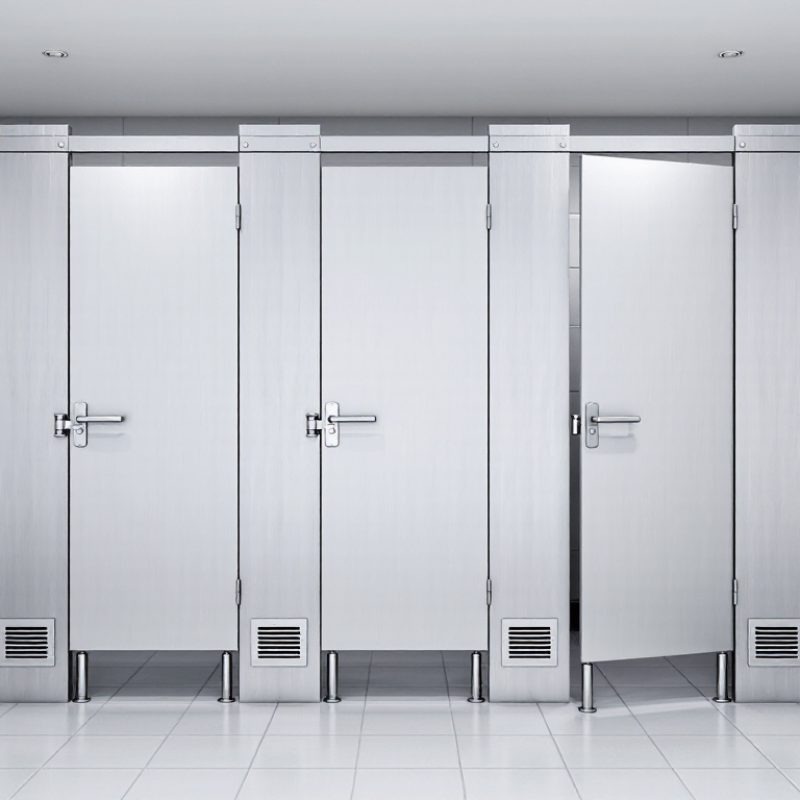
Set Clear-Opening Requirements: ADA Calls for at Least 32 in (815 mm)
For an accessible washroom, specify the required clear opening, not just the aluminium door’s nominal width. Under the ADA, the clear opening must be at least 32 inches (815 mm) when the door is open 90 degrees. This measurement runs from the door face to the opposite stop. A door listed as 32 inches wide may provide less usable space after its frame, hinges, and hardware are installed. Measure the finished opening carefully. A drawing can look generous and still miss the requirement on site. ADA applies in the United States; buyers elsewhere should confirm the relevant local accessibility rules before ordering.
Tips: Ask the supplier for the clear opening shown on a shop drawing. Check the door leaf, frame, hinges, and latch together. Leave room for installation tolerances, but do not treat extra clearance as a substitute for code review.
Before approving production, compare the drawing with the actual wall opening and intended swing. Also consider how a closer or protective plate could affect usable width. These details are easy to overlook when reviewing a catalogue dimension. If the measured opening is close to the minimum, revise the specification early. It may feel overly cautious, but changing a door after delivery is harder.
7 Aluminium Washroom Door Buying Tips for Global Buyers - Set Clear-Opening Requirements: ADA Calls for at Least 32 in (815 mm)
| Buying tip | Requirement or specification | What to confirm before ordering |
|---|---|---|
| 1. Set clear-opening requirements | Where the 2010 ADA Standards apply, an accessible door opening generally needs at least 32 in (813 mm; often rounded to 815 mm) of clear width with the door open 90 degrees. A doorway deeper than 24 in (610 mm) generally requires at least 36 in (915 mm) of clear width. | Specify the required clear opening, not just the nominal door-leaf width. Check the frame, hinges, stops, and hardware, and verify applicable local accessibility rules. |
| 2. Check maneuvering space and swing | Accessible-door maneuvering clearances vary with the approach direction, door swing, and latch or hinge side; ADA requirements are set out in Section 404.2.4 and related figures. | Provide a plan showing the corridor, adjacent walls, approach route, and door swing. Confirm that the open door will not reduce required circulation or accessible-route width. |
| 3. Specify accessible hardware | Under the ADA Standards, door hardware operable parts are generally mounted 34–48 in (865–1220 mm) above the finished floor. They must be usable with one hand without tight grasping, pinching, or wrist twisting. | Check the location and operation of locks, pulls, latches, and privacy hardware. Coordinate with the project’s accessibility and building-code requirements. |
| 4. Review opening force and closing speed | The ADA Standards limit the opening force for many interior hinged doors to 5 lbf (22.2 N), with exceptions such as fire doors. A door closer must take at least 5 seconds to move from 90 degrees open to 12 degrees from the latch. | Confirm closer, latch, and seal selections will work together while meeting the applicable force, closing-speed, fire-door, and life-safety requirements. |
| 5. Confirm threshold and floor transitions | For doors covered by ADA Section 404.2.5, thresholds generally may not exceed 1/2 in (13 mm). Changes in level are also subject to limits and beveling requirements. | Ask for the finished threshold height and transition detail, including flooring build-up. Check drainage needs without creating an inaccessible level change. |
| 6. Choose suitable aluminium and finish | Aluminium alloys and surface finishes differ in strength, appearance, and resistance to moisture and cleaning chemicals. Performance depends on the alloy, finish, installation, and exposure conditions. | Request the alloy and finish specification, cleaning guidance, and any documented corrosion-resistance testing relevant to the project environment. |
| 7. Verify glazing and complete-door details | Glazing in doors may be subject to safety-glazing requirements under the building codes applicable at the project location. Door performance also depends on the frame, hinges, fixings, and installation. | If glazing is included, confirm the required safety-glazing classification and markings. Review complete-door drawings, fixing details, and installation instructions before approval. |
FAQS
Under ADA requirements, the clear opening must be at least 32 inches (815 mm) with the door open 90 degrees. Measure from the door face to the opposite stop.
Not always. Frames, hinges, and hardware can reduce usable space. Check the finished opening, not just the catalogue size.
Confirm the clear opening, door leaf, frame, hinges, and latch together. Compare the drawing with the actual wall opening and intended swing.
Yes. These parts may reduce usable width. Check their impact before approving production. A drawing can look generous.
It indicates that the handle set passed a durability test of 200,000 operating cycles. It is a useful benchmark, not a lifespan promise.
No. Grade 7 addresses durability, not corrosion resistance. Review finish performance separately for damp washrooms.
Ask for test documents naming the specific handle model and its classification. Similar-looking hardware may have different springs, bearings, or fixings.
Correct mounting, suitable door thickness, and routine checks all matter. Site conditions vary. A test report cannot predict everything.
Conclusion
Choosing an Aluminium Washroom Door for an international project starts with the opening: confirm the required clear width and check accessibility needs in the destination market. Where applicable, ADA guidance calls for at least 32 inches (815 mm) of clear opening. Next, compare aluminium alloys and protective finishes, and request corrosion-test information, such as results from ISO 9227 testing, to judge suitability for humid or demanding environments.
Review the door and frame design against relevant EN 1999 aluminium standards, and assess hardware performance for expected use. EN 1906 Grade 7 hardware is tested for 200,000 cycles, providing a useful durability benchmark. Before ordering, also confirm moisture resistance, safety requirements, installation details, and packaging and shipping conditions for the destination. Checking these points early can help buyers select a door system that fits the building, performs reliably, and arrives ready for installation.
